



Pumpkin seed extract has quietly become one of the most researched natural alternatives for hair thinning — and the science behind it goes well beyond a trendy ingredient claim. Cold-pressed from pumpkin seeds, this extract has been shown to support hair growth, calm scalp inflammation, and deliver a concentrated dose of nutrients the scalp needs to function well.
MONPURE's Lead Trichologist, Sofia Baig, explains why it's earned its place as a hero ingredient: "Pumpkin seed oil is an amazing source of essential fatty acids, including omega-3 and omega-6 fatty acids, all of which are crucial for maintaining a healthy scalp and promoting hair growth. This clever extract contains several nutrients and antioxidants that are beneficial for our hair, including vitamins A, E, and K, as well as minerals such as zinc and magnesium. Pumpkin seed oil also contains compounds that possess anti-inflammatory properties, which help soothe irritated or inflamed scalp conditions, such as dandruff or scalp psoriasis."
"Recent hair loss research has shown that pumpkin seed oil blocks the production of DHT, the hormone responsible for hair loss. It naturally targets the hair growth cycle — initially targeting the catagen and telogen phases, working to minimise excess shedding. It then boosts the growth of follicles entering into a new cycle of the anagen phase. It's an incredible natural solution against hormonal hair loss, such as thinning during menopause and after women give birth. That's what makes it effective in preventing hair loss, which is why it's the star ingredient in MONPURE's Follicle Boost Hair Density Serum."
Hair Growth Benefits of Pumpkin Seed Extract
Pumpkin seed extract is a gentle yet effective ingredient that has been scientifically proven to block the 5-alpha reductase enzyme that produces DHT, a byproduct of testosterone that causes hair loss. It naturally targets the hair growth cycle — initially targeting the catagen and telogen phases, working to minimise excess shedding. It also boosts the growth of new follicles, leaving the telogen phase and entering into a new cycle of the anagen phase. This powerful extract also stimulates follicles, delivers nutrients, and boosts circulation to the scalp.
Pumpkin seed extract is rich in nutrients that benefit scalp and hair health, including phosphorus, zinc, magnesium, iron, vitamins E, A, riboflavin, thiamin, niacin and precious essential fatty acids (EFAs). Pumpkin seed extract has a protective effect against nutrient deficiency-driven hair loss. The antioxidants vitamin E and linoleic acid found in pumpkin seed extract hold strong anti-inflammatory effects and decrease oxidation, which also combats hair loss and boosts hair health.
Why Pumpkin Seed Oil Targets Hair Loss at the Root
Hair loss affects around 40% of women at some point in their lives, and it can take a real emotional toll — especially when it's visible. MONPURE's dermatologist Dr Sue Ann Chan advises early intervention: "If you're concerned about hair loss, it would be advisable to seek advice from a dermatologist to obtain appropriate diagnosis and medical treatment for your scalp, preferably at an earlier stage before it becomes advanced."
One of the most common causes is female pattern hair loss (FPHL) — a genetic type of hair loss that can affect women from their 30s onward, but occurs most frequently during menopause. As Dr Sue Ann explains: "It happens when the hair's growth phase slows down and the hair follicles shrink. It usually takes the form of diffuse thinning, starting from the crown of the head, but unlike male pattern hair loss, it doesn't result in complete baldness."
This is where pumpkin seed oil's mechanism becomes so relevant. One of the androgens responsible for FPHL is dihydrotestosterone (DHT), a byproduct of testosterone that increases as women age. While DHT can increase hair growth elsewhere on the body, on the scalp it shrinks the hair follicle's anagen (growth) phase and prolongs the telogen (shedding) phase. The enzyme 5-alpha reductase converts around 10% of testosterone into DHT — and this is the exact enzyme pumpkin seed oil has been shown to help block.
Pumpkin Seed Oil vs Minoxidil: What the Studies Found
The strongest evidence for women specifically comes from a 2021 randomised comparative trial published in the Journal of Cosmetic Dermatology.<sup>1</sup> Researchers enrolled 60 women with female pattern hair loss (FPHL) and split them into two groups over three months: one applying topical pumpkin seed oil daily, the other applying minoxidil 5% foam.
Both groups showed statistically significant improvements in hair growth and quality — and pumpkin seed oil actually outperformed minoxidil on one measure, showing a greater reduction in vellus hairs (the fine, non-pigmented hairs associated with follicular miniaturisation). A significant decrease in hair shaft diversity and an increase in upright regrowing hairs were also recorded in the pumpkin seed oil group. This is the study to lean on for messaging aimed at menopause- or postpartum-related hair thinning, since it was conducted directly in women.
Separately, the most-cited evidence for pumpkin seed oil's DHT-blocking mechanism comes from a 2014 randomised, double-blind, placebo-controlled trial in Evidence-Based Complementary and Alternative Medicine, which studied 76 men with mild-to-moderate androgenetic alopecia over 24 weeks.<sup>2</sup> Mean hair count increased by 40% in the pumpkin seed oil group, compared to 10% in the placebo group (P < .001) — a figure confirmed directly in the study's published abstract. Self-rated improvement and satisfaction scores were also significantly higher in the treated group. Because this trial was conducted in men, it's the right citation for the general 5-alpha reductase/DHT-blocking mechanism and efficacy claim, rather than for female-specific hormonal hair loss — the 2021 study above is the better fit for that.
Together, the two studies build a genuinely strong evidence base: one demonstrates the mechanism and measurable hair count gains, the other demonstrates real-world comparative efficacy against minoxidil specifically in women.
How to Use Pumpkin Seed Extract for Hair Growth
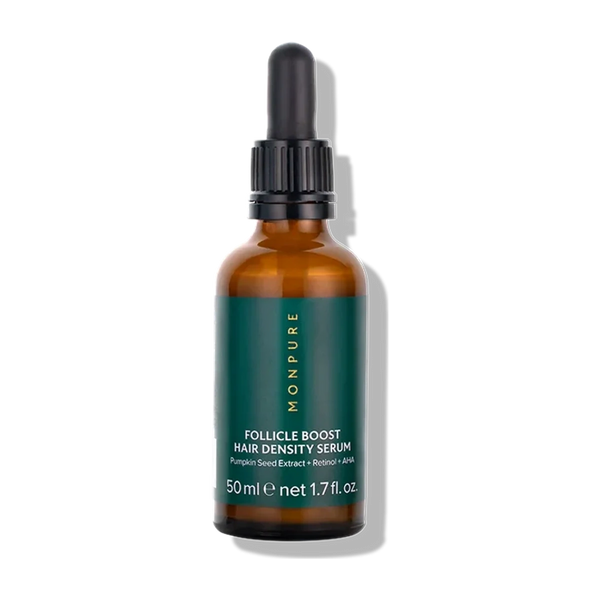
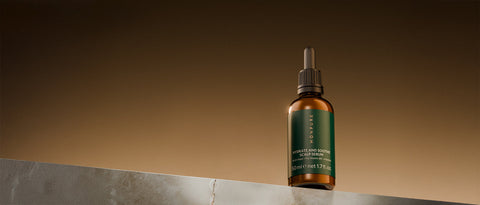
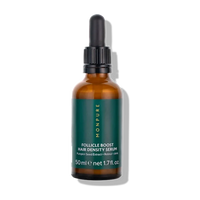
MONPURE's Follicle Boost Hair Density Serum targets hair thinning at the source by inhibiting the production of DHT. The hair growth booster features a high concentration of pumpkin seed extract. As DHT is the primary cause of hormonal hair thinning, inhibiting this process targets the condition at the hormonal level. The award-winning serum also stimulates follicles and delivers nutrients to the scalp.
"Pumpkin seed oil is a safe, natural oil extracted from pumpkin seeds. The Follicle Boost Hair Density Serum features pumpkin seed oil as its hero ingredient, and is safe to use during pregnancy and breastfeeding, which is amazing for women undergoing hormonal hair loss and changes." — Sofia Baig, Lead Trichologist
The hair growth elixir also contains follicle-feeding ingredients such as rosemary extract, castor oil and coffee arabica extract, as well as exfoliating retinol and lactic acid that work to improve cell turnover, decongest follicles and prime the scalp for optimal absorption of the serum's other hair-growth-boosting ingredients.
Step 1
As part of a morning or night routine, starting with a clean, dry or towel-dried scalp, part the hairline into 5 or more sections.
Step 2
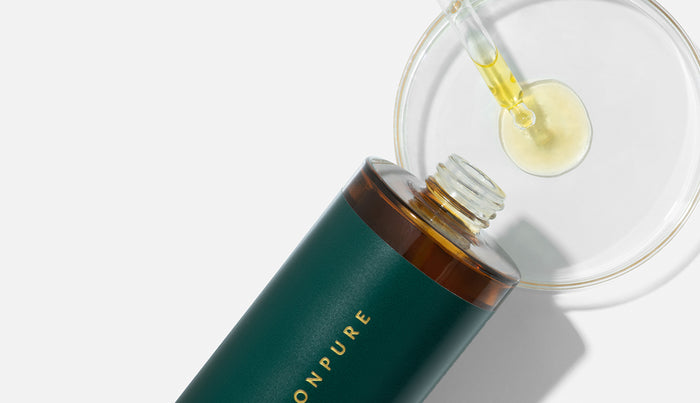
Using the pipette, apply a few drops of serum directly onto each section, approximately 3cm apart.
Step 3
Gently massage until the product has permeated the scalp. Do not rinse.
"I always say that 'consistency is key' when it comes to promoting hair growth. I suggest using the Follicle Boost Hair Density Serum daily, on areas of thinning or sparseness, to prevent excess hair loss and inhibit follicular miniaturisation — the process in which the hair follicle shrinks and shedding increases. A few drops a day will help you boost the growth of follicles entering a new cycle of the growth phase and begin your healthy hair journey." — Sofia Baig, Lead Trichologist
The Takeaway
Pumpkin seed extract is one of the most well-researched natural alternatives for hair thinning available today, backed by two separate clinical studies: one showing a 40% increase in hair count over 24 weeks, the other showing results comparable to minoxidil in women specifically. For anyone exploring options beyond minoxidil, or looking for a natural approach to hormonal hair loss during menopause or postpartum, it's an ingredient backed by genuine science rather than trend.
References
- Ibrahim, I.M., Hasan, M.S., Elsabaa, K.I., & Elsaie, M.L. (2021). Pumpkin seed oil vs. minoxidil 5% topical foam for the treatment of female pattern hair loss: A randomized comparative trial. Journal of Cosmetic Dermatology, 20(9), 2867–2873.
- Cho, Y.H., Lee, S.Y., Jeong, D.W., Choi, E.J., Kim, Y.J., Lee, J.G., Yi, Y.H., & Cha, H.S. (2014). Effect of pumpkin seed oil on hair growth in men with androgenetic alopecia: A randomized, double-blind, placebo-controlled trial. Evidence-Based Complementary and Alternative Medicine, 2014, 549721.